Why Tatu City Is Not “Normal” Nairobi Property
Tatu City is not a suburb; it is a Privatized Jurisdiction.
For buyers migrating from the organic (and often chaotic) growth of traditional Nairobi neighborhoods like Kilimani or Kileleshwa, the transition involves a steep legal learning curve. In 2026, the most frequent source of friction in Tatu City isn't construction delays or price—it is Rule Shock.
Many investors enter the market with the traditional Kenyan mindset: "I have the title; I can do what I want." In a master-planned ecosystem, that assumption is a fast track to litigation and fines.
In Tatu City, you don't just buy a plot or a house; you buy into a "Social and Architectural Contract." If you violate the contract, the city has the power to enforce compliance in ways a typical Residents' Association cannot.
This guide explains the forensic details of Developer Covenants—the "invisible" laws that protect your capital but restrict your spontaneity.

1. The Doctrine of Restricted Freedom: What are Covenants?
Developer covenants are binding legal obligations attached to the land title. Unlike municipal bylaws, which are often poorly enforced, Tatu City’s covenants are Civil Contracts that "run with the land."
2. Architectural Controls: The "Visual Covenant"
In 2026, Tatu City maintains a strict Design Review Committee (DRC). If you are buying a plot in Kijani Ridge, you cannot simply hire a contractor and start digging.
-
Approved Material Palettes: You are restricted to specific stone types, roofing colors, and fence heights.
-
The "Zero-Fence" Concept: Many precincts encourage or mandate "live" hedges or low-profile boundaries to maintain the "Open City" aesthetic.
-
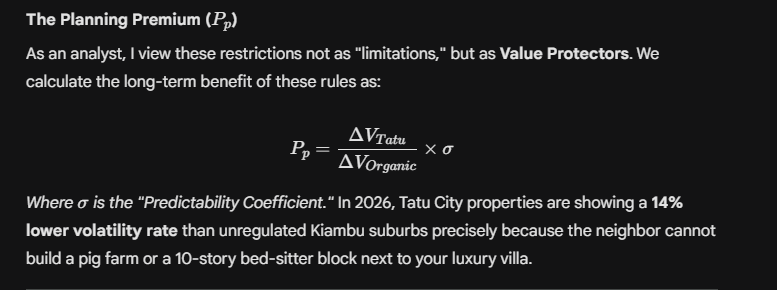
Impact on Value: This uniformity prevents "Visual Blight," ensuring that one poorly designed house doesn't drag down the valuation of the entire street.
3. Anti-Hoarding: The Construction Timeline Rule
One of the most powerful covenants in Tatu City targets speculators. Unlike the "buy and hold for 20 years" model common in the rest of Kenya, Tatu City often mandates Construction Milestones.
-
The 2-Year Rule: In many residential precincts, you must begin construction within 24 months of purchase.
-
The "Completion Bond": Some contracts require a deposit that is only refunded once the house is finished to the approved standard.
-
Strategic Outcome: This prevents Tatu from becoming a "ghost city" of empty plots, ensuring a functional, lived-in community that supports retail and school growth.
4. Use-Case Restrictions: The Death of the "Residential-Office"
In Kilimani, it’s common to see a house converted into a law firm or a noisy kindergarten overnight. In Tatu City, this is a Contractual Breach.
-
No Unapproved Commercialization: Residential zones stay residential. You cannot run a high-traffic business from your home unless it falls under specific "Home Office" guidelines that forbid external signage and client foot traffic.
-
Short-Term Rental (Airbnb) Controls: By 2026, specific precincts have introduced "Minimum Stay" rules (e.g., 30 days) to prevent the "Hotelization" of family neighborhoods. If you are an investor, you must check the specific precinct rules before counting on Airbnb yields.
5. Maintenance Obligations: The "Facade Tax"
Ownership in Tatu City comes with a "Positive Covenant" to maintain.
-
Landscaping: If your front lawn becomes an eyesore, the estate management has the right to trim it and bill you for the service.
-
External Repairs: You are legally required to keep your facade in good repair. This prevents the "decay cycle" seen in older Nairobi estates where one crumbling building triggers a neighborhood decline.
6. The Power of the Management Company (Tatu City Ltd)
In a normal estate, the "Management Company" is often a group of struggling volunteers. In Tatu City, the management is a Corporate Entity with significant teeth.
-
Service Charge Enforcement: Failure to pay service charges can result in the suspension of city-level services (water, power, or even access cards).
-
Fines and Remediation: The management can issue fines for noise complaints, improper waste disposal, or unauthorized renovations.
7. Tatu City vs. Traditional Suburbs: The Trade-off
| Feature | Tatu City (Managed) | Traditional Suburb (Organic) |
| Zoning | Rigid/Guaranteed | Fluid/Unpredictable |
| Infrastructure | Private/Maintained | Public/Neglected |
| Individual Freedom | Restricted | High |
| Resale Market | Institutional/High-Value | Retail/Variable |
| Enforcement | Immediate/Contractual | Slow/Legal System |
8. Risks for the Uninformed Buyer
-
Inherited Breaches: If you buy a resale property in Tatu City that has an unapproved extension, you inherit the fine and the order to demolish.
-
The "Speculation Trap": If you buy land with no intention to build, the "penalty fees" for non-construction can eventually eat into your capital gains.
-
Diaspora Blindness: Many diaspora buyers assume "it's my land." They return three years later to find hefty fines for unmaintained plots or missed construction deadlines.
Final Verdict: Clarity Beats Spontaneity
Tatu City in 2026 is designed for the Conservative Professional and the Institutional Investor. It is a market that rewards order and punishes "informal" flexibility.
If you value the freedom to build whatever you want, whenever you want, Tatu City is not for you. But if you value the certainty that your neighbor will never build a nightclub next to your bedroom, the covenants are your greatest asset.
Don't buy into Tatu City based on a brochure. You need to read the Master Declaration of Covenants, Conditions, and Restrictions (CC&Rs).
📞 0713595863 | 0722506632
Speak with Ochieng Wycliffe for a forensic Tatu City Pre-Purchase Audit. We review the specific precinct rules to ensure your investment goals align with the city's laws.