Kilimani is no longer a speculative play masquerading as a rental market. In January 2026, it functions as a high-velocity cash-flow district under significant operational pressure. Returns exist, but they are reserved for investors who prioritize unit economics, navigate regulatory friction with precision, and understand tenant behavior at a granular level.
This is not a suburb that rewards enthusiasm. It rewards discipline.
As a Senior Real Estate Investment Analyst at Ochieng Wycliffe, our 2026 portfolio audits reveal a market that has matured with brutal efficiency. The "Easy Money" era of the early 2020s has been replaced by a landscape where Utility Independence and Institutional-Grade management are the only shields against yield erosion.
1. From Easy Money to Tight Underwriting: How Kilimani Matured
Kilimani’s transformation was accelerated, not gradual. Between 2017 and 2023, a convergence of proximity-driven demand from Upper Hill and Westlands, combined with loose densification enforcement, created a construction frenzy. At the time, rapid absorption masked structural weaknesses in many developments.
By 2026, that mask is gone. Kilimani did not become oversupplied in absolute terms—Nairobi's housing deficit remains acute—but it became over-homogenized.
The market is currently flooded with mid-market blocks offering identical layouts. For the investor, this means your "luxury" finishes are no longer a competitive advantage; they are the baseline. To generate alpha in 2026, you must move beyond the aesthetic and into the operational.
2. Why Capital Still Flows: The Structural Persistence of Kilimani
Despite the saturation narrative, apartments for sale in Kilimani continue to transact with consistent liquidity. This persistence is structural, not emotional, driven by three 2026 realities:
-
Commute Economics: In the 2026 "15-minute city" model, location is not about prestige—it is about time. Kilimani remains perfectly positioned between the city’s primary employment nodes. Tenants are willing to sacrifice space for a 10-minute commute to Westlands or Upper Hill.
-
Downsizing Trends: Our rental data shows a clear behavioral shift: tenants now downsize before they relocate. Efficient 1 & 2 bedroom apartments for sale are clearing the market 3x faster than traditional 3-bedroom units as families optimize their budgets against 2026 inflation.
-
Diaspora Liquidity: With local mortgage rates hovering between 14% and 16%, the market is overwhelmingly cash-driven. Kilimani’s pricing bands (KES 6.5M to 15M) remain the most accessible entry point for Diaspora buyers seeking predictable rental income and exit liquidity.
3. Micro-Market Fragmentation: A Street-Level Reality
Kilimani cannot be underwritten as a single entity in 2026. Performance is now hyper-local, dictated by street-level infrastructure and the Utility Independence Benchmark.
Kindaruma Road
Newer developments here face price resistance. Without strong differentiation—such as an industrial-grade Reverse Osmosis (RO) plant or dual-lift systems—units on Kindaruma are being commoditized.
Kirichwa Road
Conversely, older, well-managed buildings on Kirichwa Road are quietly outperforming on net yield. These assets benefit from lower entry costs and established resident associations that have successfully guarded against service charge inflation.
The Argwings Kodhek Corridor
This is the epicenter of Airbnb Kilimani. Short-let density is at its peak here, and competition is fierce. Success near properties near Yaya Centre now hinges on "Hospitality-Grade" amenities: noise insulation, high-speed fiber failovers, and smart-lock access systems.
4. The End of Speculative Density: 2026 Zoning Enforcement
The 2026 Nairobi City County Zoning Gazettement has altered Kilimani’s trajectory through enforcement discipline rather than outright restriction. The era of "anything goes" density is over.
-
Infrastructure Scrutiny: Approvals are now strictly tied to sewer capacity and road access width.
-
Parking Ratios: The 2026 mandate requires a minimum of 1.2 bays per unit for 2-bedroom apartments, a rule that has effectively constrained future oversupply by making many small-plot developments financially unviable.
The implication for current owners: Your existing inventory is now protected by a "Supply Ceiling." As new approvals slow down, high-quality existing units will see a gradual absorption premium.
5. Short-Lets: From Yield Hack to Operating Business
Short-term rentals once compensated for weak unit fundamentals. In 2026, that compensation has eroded. Airbnb Kilimani has matured from a side-hustle into a professionalized hospitality sector.
To maintain a competitive rental yield in Kilimani through short-lets, the asset must function as a mini-hotel. Buildings with centralized management desks, laundry services, and "Utility Independence" (100% power backup) are maintaining 70% occupancy. Those without these features are seeing occupancy dip below 40%, forcing owners back into the long-term rental market.
6. Unit Economics: The 2026 Underwriting Matrix
The most important question in 2026 is: Which unit types clear demand with minimal friction?
The Net Yield Formula
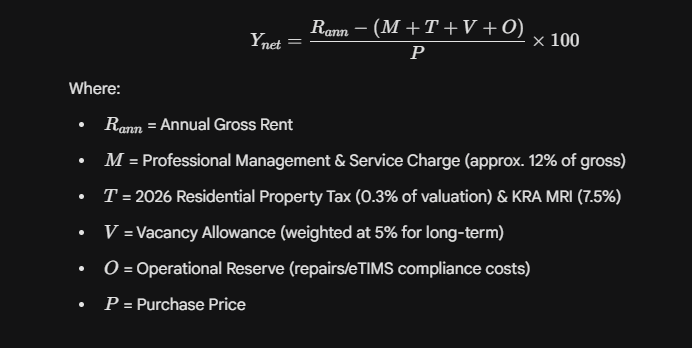
We calculate the 2026 Net Yield ($Y_{net}$) by accounting for the increased operational costs of the current market:
Kilimani Performance Table (Long-Term Lease)
| Unit Type | Avg Price (KES) | Avg Rent (KES) | Gross Yield | Net Yield (Realized) |
| Studio | 6.5M | 55,000 | 10.1% | 7.8% |
| 1-Bedroom | 9.5M | 75,000 | 9.5% | 7.1% |
| 2-Bedroom | 14.5M | 105,000 | 8.7% | 6.4% |
| 3-Bedroom | 19.0M | 130,000 | 8.2% | 5.9% |
Note: Short-let (Airbnb) strategies can push net yields to 11%, but only if the "Utility Independence" standard is met.
7. ESG and Reliability: The New Liquidity Filter
In 2026, Environmental, Social, and Governance (ESG) alignment has shifted from a marketing buzzword to a liquidity requirement. Institutional buyers and structured funds now use a "Reliability Filter" when purchasing blocks in Kilimani.
Developments with solar-assisted common areas, high-efficiency water storage, and eTIMS-integrated management systems are leased faster and sold more smoothly. If your building relies on diesel generators and water bowsers, your asset is "Illiquid" in the 2026 secondary market.
8. The Verdict: Kilimani Rewards Discipline
Kilimani did not lose relevance; it lost its tolerance for weak decisions. It remains the most liquid rental market in Nairobi, but it is now an "Operational Risk" environment.
-
Well-suited for: Diaspora investors seeking consistent cash flow and those comfortable with active professional management.
-
Poor fit for: Investors seeking aggressive capital appreciation or hands-off, passive ownership of legacy buildings.
Returns in 2026 exist for those who treat property as a business, not a trophy. The focus must be on Utility Independence, tax compliance through eTIMS, and targeting the "Efficiency Demand" of the modern Nairobi professional.
Ready to capitalize on the Kilimani cash-flow reset? Secure your position in Nairobi’s most liquid rental district.
Contact Ochieng Wycliffe today for an exclusive Kilimani Portfolio Risk Review and a private briefing on the 2026 zoning enforcement impact.
📞 0713595863 | 0722506632